


On March 15, 2023, CafeBiz reported on Base.vn's program for the business community in Central Vietnam and mentioned MarArting in the list of partners. Two days later, the event took place in Da Nang. Looking back at the pre-show presentation, we wanted to tell it from a different angle than the launch narrative: what does a person who has never used a product need to read in an invitation to decide to spend the afternoon at a technology conference?
The reader is considering a period of time
When a business owner opens an invitation, he or she is often in the middle of a lot of work. The afternoon scheduled may coincide with warehouse inspection, salary review, or guest reception. A formal headline isn't enough to let them know if they should be assigned a replacement. What's compelling is often a problem they recognize right away: how to know what's coming next, or why parts send up different figures. The more specific the invitation is, the easier it will be for the recipient to judge for himself.
For the writer, a simple experiment is to remove the event's name from the introduction and have a colleague read it over. Does the person have any idea who the program is for and what questions they might bring? If the answer is just a conference for all businesses interested in innovation, it may be too broad. You can start with two typical situations, such as a company opening a second facility and a business that wants to unify how it tracks revenues and expenditures between departments.
Put information in the order the reader needs
An easy - to - use registration page usually helps guests answer three questions in turn: where the session is relevant to them, if they can attend it, and what to do to hold the seat. Dates, addresses, forms of attendance and how to receive confirmations can be put together. Viewers on the phone may be standing outside the store or reading quickly between two meetings. If they have to open another poster and zoom in to read the time, it's easy for them to save it and forget it.
For professional topics, your introduction should also help your reader pick the right session. A paragraph that only lists hard titles shows what the listener can ask. Instead, specify the context in which the speaker has experience, for example managing an educational institution or running a retail business across multiple stages. It's easier for someone in a similar situation to decide to participate. This is MarArting's editorial suggestion when looking back at an event newsletter, not describing the categories that the agency has done for the organizers.
Companion and organization are the two roles to call right
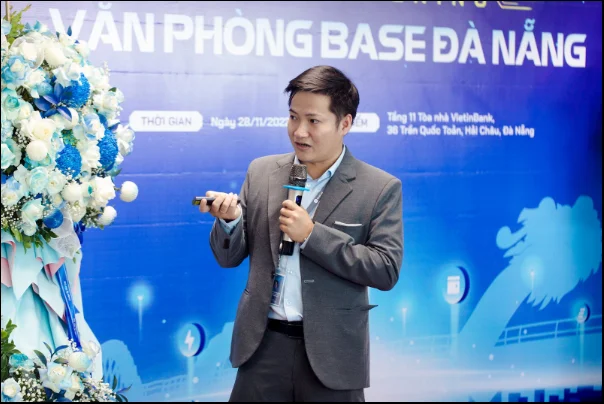
On a stage there can be many logos: organizers, media partners, companions and sponsors. To the reader, these names have different meanings. In this story, Base.vn is the launcher of the solution, while MarArting is the companion. Therefore, when writing on our website, we put the agency name next to the right role and keep the subject of the product clear. An accurate inscription helps both attendees and partners understand how the parties appear in the show.
How to validate roles can be very practical. Before posting a general introduction, agree on how to write the name of each unit and who has the authority to confirm the change. Check the name on the form, on the photo, and in the text message. By the date of the event, a stage panorama can record how the parties were actually introduced. When you use the image again later, make sure that the caption says exactly what you saw. The logo on the stage is the basis for the presence, while each work item needs its own basis.
From clicks to a usable subscription
For a business program, the number of clicks on the post is just the starting point. The team in charge often also has to answer who is registered, can they be contacted and which sessions they are interested in. A form that's too long can leave the reader hanging. But if you ask for just one name and you're missing a confirmation channel, it's hard to get support. The balancing act is to test each information field with a question: after collecting it, who will use it and what will they use it for?
For example, if the show has multiple parallel sessions, knowing the guest's choices can help with room placement. If there is no specific purpose for asking the size of the revenue, it is possible to remove that sentence from the initial registration step. This will also help the person on duty with shorter guest instructions. A good test would be to fill out the form yourself on the phone, check the confirmation, and then ask someone who doesn't know the location to try to figure out how to navigate from the information you just received. The ones that have to be asked are the ones that need fixing.

Each channel has a job to do
The same show can appear in newspapers, registration pages, partners' social networks, and invitations from the organizers. People who read the news often want to understand the context, while people who leave behind information need to know which door to go to and what time to pick up the guests. Copying a whole paragraph for every channel causes both groups to filter themselves. It is possible to keep the program name and the parties' roles unified, then write the rest according to the individual tasks of each contact point.
A post from a partner can explain why the topic is of interest to their community and get people to attend the right place to sign up. A calendar reminder email can prioritize your map, time of arrival, and contacts. After the event, the link in your summary should take your reader to something that is still usable, such as a narrative piece or an actual image. That's why on the MarArting website, this post leads to the post about the launch date in Da Nang, when the registration form has completed its task.
Evaluate the invitation after the hall has closed
One way to read the result is to break the journey into three milestones: who understood the program, who signed up, and who was actually present. Each gap tells a story. Having many readers but few subscribers may be because the topic is unknown or the timing is inappropriate. Many people sign up, but few come, which can be related to scheduling reminders or changes in personal plans. Before concluding which channel is effective, review the direct response and ask the receptionist what they've been most troubled with.
With MarArting, the residual value of a good invitation is that the recipient can respond easily even if they choose not to attend. They know who's running it, why it's relevant to their work, and where they can retrieve information. The pre-event newsletter and the day's images complement each other in exactly the same order. One shows what the organizers wanted to showcase, the other helps readers see how the program was present in the Central.
View image of Base Finance+ launch day
Original source: CafeBiz, 15/03/2023.
View all press coverage