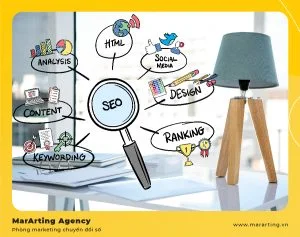
The goal of any online business is to appear on the top of the search engine search results (SEO). Therefore, the implementation of an effective SEO campaign is very important. But did you know that there are some important factors in On-Page SEO that you need to know and implement properly to achieve the best effect?
Besides building quality links to enhance Off-Page SEO is also an integral part of your SEO strategy? And be wary of Black Hat SEO techniques, as they can provide short-term benefits but threaten the stability and success of your website. This article will reveal important SEO secrets that give you detailed instructions on how to implement them.
Contents
Important Elements in On-Page SEO You Need to Know
When it comes to On-Page SEO, the following key factors will play an important role in optimizing your website:
Page Title (Title Tag) in SEO
Page title is one of the most important elements in On-Page SEO. So make sure that the page title contains the main keyword and accurately describes the content of the page.
Page Description (Meta Description) to Create Effective SEO
The page description does not directly affect site rankings, but has a significant impact on users clicking on links from search results. Make your description engaging, intriguing, and contain your main keywords.
Optimized URLs for effective SEO
Create a short, easy - to - read URL that contains your main keywords. This makes it easier for users and search engines to understand the content of the site.
Quality Content in SEO
Write quality content that meets the needs of users. Use keywords naturally in your content and share useful and reliable information.
Evaluate HTML Structure in SEO
Using a logical HTML structure with header tags (H1, H2, H3, ...), ensuring logical structure and easy to read for both users and search engines.
Build Quality Links to Enhance Off-Page SEO
Quality link building is an important factor in improving Off-Page SEO. Here are some things you should keep in mind:
Links from reputable websites
Search reputable and relevant websites in your field to build links. Links from highly trusted websites enhance the trust and credibility of your website.
Create natural links
Create quality and engaging content to attract interest from users and other websites. Natural links will be formed when your content is shared and appreciated.
Internal links
Create internal links between pages of your website. Search engines will have a better understanding of the structure of your website. This will increase your surfing and search for content on your website.
Black Hat SEO techniques and why you should avoid them

There are a number of Black Hat SEO techniques that you should avoid, because they can provide short-term benefits but can do serious harm to your website in the future:
Create spam links
Batch unnatural or valueless links from unrelated websites. This can lead to penalties and a reduction in your site's rankings.
Creating unqualified content
Use copied, unvalued, or irrelevant content to try to increase site rankings. Search engines are getting smarter and smarter and will detect and process websites with bad content.
Hide text or keywords
Try to hide text or keywords using background - like colors, micro-sizes, or hidden CSS. Search engines can detect and process these techniques.
SEO and UX: Great recipe to increase engagement and on-page time

SEO and user experience (UX) are inseparable. Optimize your website to attract users and increase engagement. It is also to create a good experience and meet the needs of users. Some important factors in combining SEO and UX are:
Fast page loading speed
A fast website helps improve user experience and customer retention. At the same time, search engines appreciate sites that have fast page loading speeds.
Responsive design
Make sure the website is designed to accommodate different mobile devices and screen sizes. This helps improve the user experience and ensures that the website displays well on any device.
Improved user-friendliness
Create an easy to use and read interface and experience. This makes it easier for users to find information, increases time on the page, and increases engagement.
Using schema markup to improve SEO and better search results display

Schema markup is a data - based markup that provides information. This will allow search engines to better understand the content of your website. This helps improve SEO and display search results better. Through presenting important and attractive information in search results.
SEO and voice search: Take advantage of voice search trends

With the development of virtual assistants and voice - enabled devices, voice search is becoming a popular search trend. To take advantage of this trend and improve your SEO, take note of the following factors:
Keyword research voice search in SEO
Learn about how people use voice to search for information and create content based on popular voice search keywords.
Optimize content for your voice
Write content that is natural and easy to understand, like you are talking to a person. Use questions and direct sentences to be compatible with voice queries.
Improve the site for direct feedback
Provides answers to common questions and direct responses to voice queries. Create content that is responsive and organized. From there the virtual assistant can understand and present the results to the user.
Optimize location information
Locate your business and provide accurate location information in your content. This improves the likelihood of appearing in local search results.
With the implementation of key elements in On-Page SEO, building quality links, avoiding Black Hat SEO techniques, leveraging SEO and UX interaction, using schema markup, creating SEO-optimized Landing Page pages and leveraging voice search trends, ... You will have a powerful and effective SEO campaign to dominate the search engine rankings.
Mobile site optimization to improve SEO and user experience
Mobile site optimization helps you boost SEO. It also improves user experience and increases conversion rates. Ensure that your website is compatible and optimized for mobile devices. This is an important step to success in today's online environment.
Responsive Design
Use responsive design so the website adapts automatically to the user's screen size and device.
Simplified interface
Eliminate unnecessary elements, keep the interface clean and minimalistic so that users can easily search for information and take action.
Optimize your image
Compress images to reduce file size and increase page load speed. Use the appropriate image format such as WebP or JPEG 2000.
Use short codes and easy-to-click links
Make sure the links and click buttons are large enough to be easy to click and avoid overlap.
Use vertical layouts
The content and navigation should be arranged vertically. From there users can scroll easily and search for information.
Use clear calls to action
Place key activity and call to action buttons in a conspicuous and easily accessible location on a mobile site.
Ensure integration of maps and contact information
If your business has a local element, make sure to include a map and contact information that is clear and easy to find on a mobile website.
Check page load speed
Use tools to test and improve page loading performance on mobile websites.
Using AMP (Accelerated Mobile Pages)
AMP is a fast framework for creating mobile websites that optimizes page loading speed. Consider implementing AMP for important pages on your website.
Check for compatibility with different mobile devices
Ensure that your mobile website displays properly on different mobile devices. Besides that the it also displays correctly on different browsers.
Make sure links and buttons work is easy to click
Make sure the links and buttons that work on the mobile site are easy to click. It is also not difficult for mobile users.
Translated from the Vietnamese original using VinAI Translate.