
A useful marketing budget starts with a decision, not a percentage copied from another company. How much cash can the business safely commit? Which customers can the team serve? What evidence would justify spending more, and what signal would make the team pull back? This guide turns those questions into three practical scenarios: cautious, base, and expansion. It then shows how to review actual spending, lead quality, sales capacity, and contribution each week. All amounts and outcomes in the worked example are invented for teaching. They do not represent MarArting or a client.

Start with the business decision
Write the outcome you want from the planning period before assigning a budget to channels. “More awareness” can be a valid aim, but it requires different evidence from “twenty new customers.” For a customer acquisition goal, record the number of customers, expected contribution per sale, time to close, and number of qualified enquiries the sales team can handle. For a new market test, state what you need to learn: which audience responds, which promise they understand, and whether the first conversations justify a larger experiment. A trial can be worthwhile before it is profitable, provided it answers a defined question.
Next, identify hard limits. Payroll, stock, delivery obligations, taxes, and a cash reserve cannot quietly become an advertising allowance. State the most the business can pay during the period and when the cash will actually leave the account. A sale booked today but paid in sixty days does not solve this week’s cash need. Review the marketing plan beside the cash-flow forecast. If the sales team is already struggling to respond, extra leads may waste money and damage the customer experience. Capacity is a budget constraint, not an afterthought.
Build a complete cost picture
Separate fixed, variable, and opportunity costs. Fixed costs may include staff, an essential subscription, or a content production contract that continues even when paid distribution pauses. Variable costs include media spend, performance fees, promotion, and creative work tied to a campaign. Opportunity cost is the time a founder, specialist, or salesperson spends approving, following up, and serving the resulting demand. It may not appear in an advertising dashboard, yet it affects whether growth is worthwhile.
Avoid double counting. If design is included in a monthly content contract, do not allocate the same invoice to every advertisement again. If a landing page is built specifically for a campaign, do not omit it because it was paid before launch. Give every cost line a name, an owner, and a record that can be reconciled. Distinguish taxes, payment fees, discounts, refunds, and shipping when they change the amount the business keeps. The point is not to make an impressive spreadsheet. It is to know which cost can be adjusted this week and which requires a longer decision.
Choose the right denominator for acquisition cost
Customer acquisition cost, or CAC, depends on the costs included and the customers counted. If the numerator includes marketing and sales expenses, say so. If it includes only paid media, call the result paid-media cost per customer rather than total CAC. Use a matching time window, then explain any lag between first enquiry and purchase. Keep leads, qualified leads, meetings, contracts, paying customers, and collected cash in separate columns. A low cost per lead is not proof of a healthy acquisition system.
Revenue alone is also an incomplete test. Subtract product cost and the variable work needed to fulfil an order to estimate contribution. A service business may need to account for delivery hours, contractors, support, and revisions. An online store may need to include marketplace fees, shipping, returns, and discounts. If reliable figures are unavailable, use a range and label the assumption. A precise-looking number based on weak inputs can make a bad decision feel safe. The related MarArting guide on calculating CAC and customer lifetime value for small businesses explains that comparison in more detail; this budget model uses those measures as decision limits.
Establish a base case you can test
Imagine a small business that can commit up to VND 60 million for a one-month experiment. This is an editorial example. It allocates VND 12 million to content and a landing page, VND 6 million to tools and measurement, VND 30 million to distribution, VND 6 million to message tests, and VND 6 million to contingency. The five amounts total VND 60 million. If an operating budget already pays for staff or tools, note that explicitly; readers should not mistake the entire total for media spend.
Turn the desired result into a forecast with visible assumptions. Suppose the business wants twenty new customers, expects 20% of qualified leads to buy, and expects 50% of all leads to qualify. It would need about one hundred qualified leads and two hundred initial leads if both rates hold. That is planning arithmetic, not a promise. If last month provided only ten leads, the rates are too uncertain to support a large commitment. Begin with a smaller test and revise them as evidence accumulates. Also ask whether anyone can respond promptly to two hundred contacts. A mathematically plausible funnel can fail operationally.
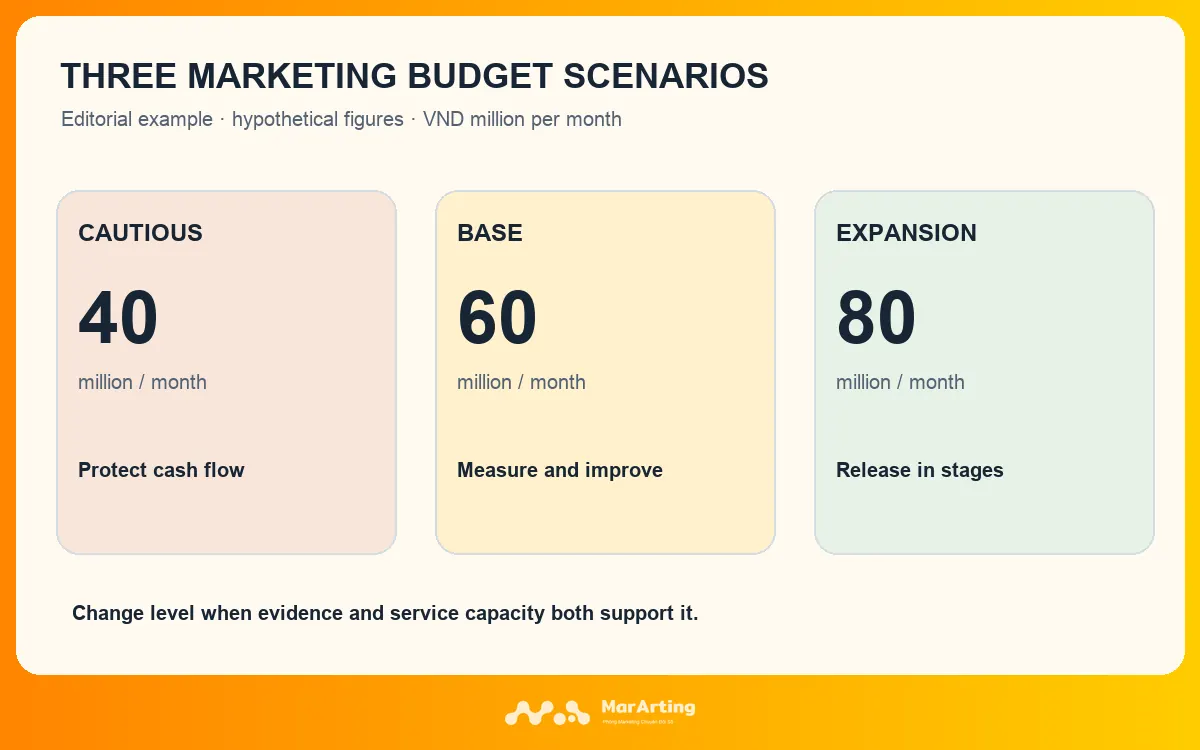
Three scenarios: cautious, base, and expansion
The cautious scenario protects cash when demand is weak, measurement is unreliable, or the team is overloaded. In our example its ceiling is VND 40 million. Keep the activities needed to maintain the system, reduce expensive experiments, and distribute only where there is credible evidence. Do not assume the lower budget can deliver the base case’s customer target. Write down which activities are delayed and what would permit them to resume. An across-the-board percentage cut may preserve weak channels while starving a useful one.
The base scenario uses the VND 60 million allocation. It fits a period when lead quality, response speed, and contribution are near the assumptions. The expansion scenario allows up to VND 80 million, but its extra VND 20 million is conditional. The business could release it in VND 5 million steps only when qualified leads increase, meeting rates remain acceptable, and the sales team still has capacity. A single unusually large order should not trigger all four steps. Give each scenario its own purpose, spending ceiling, decision threshold, and next review date. This turns the budget into an operating tool.
The three figures are examples, not recommended amounts for every company or market. A business with thin margins or a long collection cycle may require a much smaller trial. Another business with proven demand and sufficient cash may choose different levels. What matters is that the movement between levels is explained before the team is under pressure to spend or to cut.
Allocate across the customer journey
It is tempting to spend everything on conversion ads because purchases are easy to see at the end of the funnel. But if buyers do not understand the offer, the site lacks evidence, or the sales response is poor, more traffic can simply produce a larger bill. Allocate resources to the questions customers actually ask: what problem is solved, who the product fits, how the offer compares, and what happens after an enquiry. Content, a useful page, customer support, and measurement may all compete with paid distribution for the same money.
Do not pretend that every channel has the same job or measurement horizon. Search can capture existing demand; educational content may help create or clarify it; email can support people who are already considering a purchase. Record the role of each channel and the outcome you expect to observe within the period. The budget should leave room for both a near-term response and learning that improves later decisions. If an activity cannot be tied to a question or outcome, challenge it before approving it.
Match the spending period to the sales cycle
Use a period that reflects how buyers make decisions. A two-week test may be enough to detect a broken form or an unsuitable message, but rarely proves the lifetime value of a newly acquired customer. A longer sales cycle means this month’s spend may generate next month’s contracts. Keep cohorts and dates clear. If you compare spending from one month with all sales from that same month, you may credit the wrong campaign or penalize a test before its leads mature.
At the same time, do not wait for a final sale before checking basic health. Track whether leads arrived, were qualified, received a timely response, and reached a meeting. These are not substitutes for customers or contribution, but they show where the chain is breaking. Tell the team when each number becomes reliable. The owner should know which figures are final, which are estimates, and which are still waiting for a CRM update.
Set a weekly reconciliation rhythm
Choose a fixed time to reconcile media invoices, platform reports, analytics, and sales records. Use the same timezone and date range across sources. Google Ads can report spending and budget behaviour, but its platform view does not automatically include all production costs or offline sales. Analytics can describe user behaviour, yet a website event is not the same as a paid customer. The CRM or sales ledger should confirm qualification, contracts, and money received. Write down discrepancies instead of silently forcing the figures to agree.
For each channel, record its planned spend, actual spend, remaining commitment, leads, qualified leads, meetings, customers, and estimated contribution. Add a note for tracking problems, delayed invoices, and changes in attribution. If you cannot identify which contact became a customer, report the limitation openly. A rough but honest decision can be better than a polished dashboard built from incompatible definitions. The business should be able to trace the figures back to their owners.
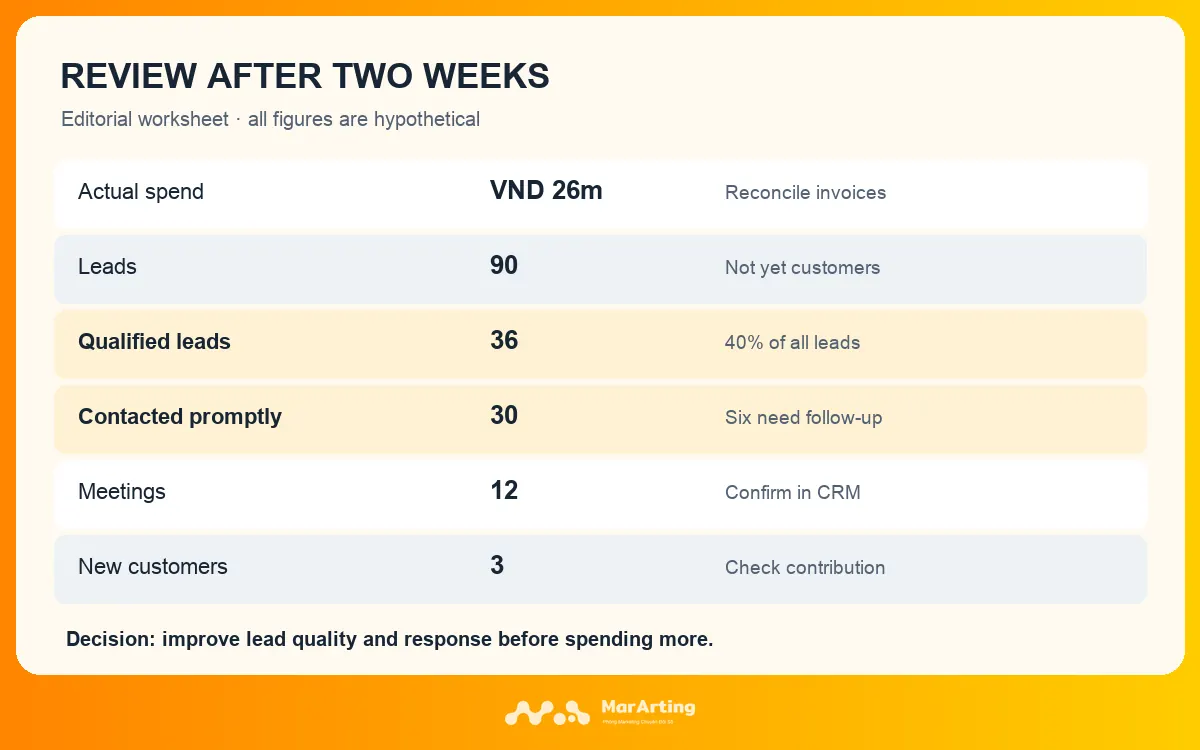
Read the two-week example carefully
Suppose the business has spent VND 26 million of the VND 60 million base case after two weeks. It has received ninety leads, of which thirty-six qualify. Sales has contacted thirty of those in time, booked twelve meetings, and gained three customers. Every figure in this paragraph is invented. Ninety leads looks close to half the monthly forecast of two hundred, but the qualification rate is 40%, below the assumed 50%. Six qualified leads have not yet received a timely response. Increasing media spend could amplify both problems.
The first decision may be to improve targeting and the sales response. Review which messages produced unsuitable contacts, whether the form asks a useful qualifying question, and why six people waited. Then see whether the twelve meetings and three customers match the expected sales cycle. If those customers have lower contribution than planned or remain inside a refund window, avoid calling the experiment profitable. An increase should depend on verified quality and the team’s ability to serve the extra demand, not only on the count at the top of the funnel.
Now imagine one small audience segment brings strong qualified leads but has reached its current cap. The team could move a limited amount from a weak segment to that one while keeping the total VND 60 million ceiling. Record the amount, the evidence, the owner, and the next observation threshold. That is a more controlled decision than raising the total budget just to compensate for an attractive lead chart. The cautious and expansion scenarios remain available if the broader evidence changes.
Define when to change scenarios
Move toward the cautious scenario if cash tightens, stock or service capacity falls, qualified-lead rates weaken across meaningful observations, or measurement fails in a way that prevents sound decisions. Before reducing spend, distinguish money already committed from money that can actually be paused. Check contractual terms and any campaign delivery limits. A planned cut that cannot be executed this week is not a useful cash forecast.
Return to the base case when inputs and operational capacity recover. Consider expansion only after more than one lucky week: a sufficient sample, CRM confirmation, acceptable contribution, and a named person able to monitor the additional leads. A channel can scale in traffic while its best audience becomes saturated and its lead quality deteriorates. Release a small increment, review it, and keep the authority to stop. The question is whether the next unit of spend appears justified, not whether last month’s average looked good.
Record the date, decision maker, amount moved, assumption changed, and review date. Do not erase the old scenario. Its history explains what the team knew at the time and helps separate a reasonable decision based on an incorrect assumption from a decision made without evidence. A short decision log often has more practical value than a dashboard with many colours and no action field.
Hold a twenty-minute budget meeting
The weekly meeting can answer five questions. How much has actually been spent, and what has not yet been invoiced? Which outcomes have been confirmed in the CRM or sales ledger? Where is the largest customer-journey bottleneck? Does the current scenario still fit cash and service capacity? What will the team keep, cut, or test next week, who owns it, and when will it be checked? Write the answer in the budget sheet while everyone is present.
In a small team one person may cover several roles, but the figures still need independent confirmation where possible. Marketing explains spending and early signals; sales verifies lead quality, meetings, and lost opportunities; finance or the owner confirms available cash and contribution. Agree on a data cut-off before the meeting. If records are incomplete, make a temporary decision with a stated review condition rather than presenting the missing data as a confident conclusion.
A worksheet to build now
Create columns for period, objective, scenario, fixed costs, variable costs, contingency, total ceiling, actual spend, leads, qualified leads, meetings, new customers, estimated contribution, and next decision. Add the data source, owner, and date each figure was locked. Enter the cash that can really be committed first. Then add forecast outcomes and label assumptions separately from confirmed results. The first version does not require complex formulas; it requires definitions that everyone using it understands.
Copy the structure for cautious, base, and expansion. For each one, write the trigger, the costs that change, the maximum commitment, and the review date. Select one small experiment that addresses the present bottleneck and reserve space to record what it taught you. If you want a budget tailored to your business, prepare three months of channel spending, CRM outcomes, sales capacity, and contribution from a representative order before asking for advice. MarArting can help structure the discussion, but a universal percentage cannot replace a review of those inputs.
Sources and scope
Sources: U.S. Small Business Administration, “Manage your business”; Google Ads Help, “About spending limits” and “Budgets overview”; Google Analytics Help documentation on reporting and conversion measurement. The scenario amounts, tables, lead counts, and customer results are original editorial examples. They show how to test a decision; they are not evidence of results achieved by MarArting or a specific business.
Frequently asked questions
What percentage of revenue should a small business spend on marketing?
No single percentage fits every business. Start with the objective, contribution, cash flow, and capacity to serve customers. Test a bounded amount and review it against actual outcomes.
Should we increase the budget when lead volume rises?
Only consider it when qualified leads, meetings, customers, and contribution also support the increase. If sales cannot handle the leads already arriving, improve the process first.
How often should we review the budget?
Check the spending pace briefly each day during an active test. Reconcile costs and outcomes weekly or at a rhythm that fits the sales cycle, then make a recorded decision.
Translated from the Vietnamese original using VinAI Translate.