
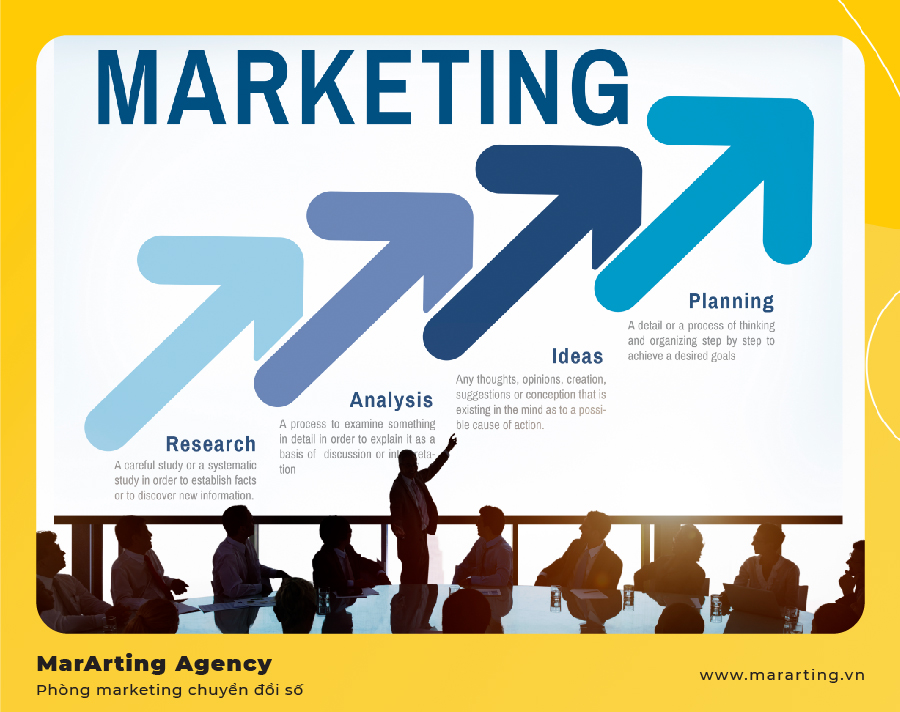
In today's competitive business world, strategy Marketing not merely a set of advertising tools. It is also an opportunity to build a strong brand and attract customers.
Contents
The Importance of Marketing Strategy in Branding and Customer Attraction

The same point over some benefits that effective marketing strategies bring:
Build a unique brand
Build positive interactions
Creating a brand identity
Attract your target customers
Product/ Service Value Shaping
Determine the strategic objectives Marketing towards

In the work... Build a Marketing Strategy effectiveness, the determination of the goal is an important step that can not be ignored. Goals shape the direction and create a specific guideline for your marketing activities. Understanding both your business's long - term and short - term goals will help you determine the right strategic directions. Here's how to define your marketing strategy goals:
Understand the long-term and short-term goals of the business
Long Term Goals:
This is the overall goal that the business wants to achieve in the future.
Long - term goals can involve sales growth, expanding markets, building a strong brand, or improving the company's image.
Understanding your long - term goals will help you shape your long - run strategy and create a marketing plan that works for you.
Short Term Objectives:
This is a goal that can be achieved in a shorter period of time, usually from a few months to a year.
Short - term goals may involve increasing the number of new customers, increasing social interaction. It can also be to increase the conversion rate from prospects to actual customers.
Identify your goals
M.A.R.T. Goals: Goals should be specific, measurable, feasible, featable, and time - bound (S.M.A.R.T.).
Target classification: Determine targets by each aspect of marketing such as sales growth target, brand identity target. It can also be the goal of increasing online interaction, the goal of creating branding.
Prioritize goals: Determine the priority of each goal to focus resources on the most important goals and bring the highest value to the business.
Market segmentation Marketing

An important factor in focusing resources and creating effective interactions with different customers is market segmentation. It helps you better understand the needs, preferences, and special factors of each customer group. From there create the right marketing strategies and optimize performance.
Analyze and identify potential customers
Data Collection
Start by gathering data about customers who may be interested in your product or service.
This data can include age, gender, geographic location, income, interests, goals, and even online behavior.
Analysis of data
Use analytics tools to analyze data and identify patterns and general trends in customer behavior and preferences.
You'll be able to identify common characteristics and also differences between customer groups.
Identify the customer audience
Based on the data and analysis, identify the potential customer audience.
Divide the customer group into specific segments based on factors such as age, interests, needs, goals, and shopping behaviors.
Identify the special elements and the differences of each segment
In-depth Study on Each Segment: Learn about the age, gender, income, interests, needs and preferences of each customer group.
Analysis of Shopping Behavior: How do customers shop? Where do they get their information? Do they tend to shop online or in - store? Analysis of shopping behavior helps you delve into how they interact with the market and product.
Recognize Special Needs: Each segment has special needs and problems. Identify these needs and how your product or service can address them.
Identify Differences: Compare the distinctive elements and needs of each segment to identify differences. From there, understand what makes each customer group unique. Look for opportunities to make deep connections and show that you understand them.
Research and Analysis of Marketing Strategies

Research direct and indirect competitors
Direct Competitors: These are businesses that offer the same type of product or service and can compete directly with you in the market. Research on this competitor involves learning about their product, price, marketing strategy, market position, and strengths and weaknesses.
Indirect Competitors: These are businesses that do not offer the same type of product or service directly, but may influence your market. For example, alternative products or other solutions may be indirect competitors.
Evaluate the Marketing strategy of the competitors
SWOT Analysis: Using SWOT analysis to assess the strengths, weaknesses, opportunities and risks of competitors.
Marketing Strategy: Consider your competitor's marketing strategy, including what marketing channels they use, what their message is, and how they interact with customers.
Success and Backing: The study of the successes that competitors have achieved and the backing that may influence their marketing strategy.
Create strategies based on competitive research
Take advantage of Untapped Opportunities: After analyzing your competitors, look for opportunities that they have n't tapped or focused on. Create new products or services to meet unmet needs. Use differentiated marketing channels. Focus on areas that your opponent is n't looking at.
Optimize Strengths: Based on competitors' SWOT analysis, find ways to optimize your business' strengths. Create a marketing strategy that highlights the areas where you have an advantage over your competitors.
Adjust your pricing strategy: Based on information about your competitors' prices, you can adjust your pricing strategies. Offer lower price to compete directly. Create unique value to rationalize higher prices.
Channel Optimization: Identify which marketing channels your competitors are using successfully and consider how to optimize their use. It could be an increase in online presence. Use social media or create a groundbreaking advertising campaign.
Unique Value proposition (UVP): UVP is the unique and attractiveness that you offer to your customers and helps you stand out in a competitive market.
Build messages and create marketing strategy value

Message matching
Identify Brand Identity: First, identify the core elements of the brand such as values, goals, mission, and guidelines. These elements will help shape the message and how you want to present your brand.
Unique Slogan: Build a short, memorable slogan that expresses the core values of the brand. The slogan helps to create identification and engagement with customers.
Message and Value: Brand messages should reflect your core values. Make sure that your message and values highlight your uniqueness and appeal.
Define the core values of the brand
Customer Validation: Define the benefits and values that your product or service brings to customers. Help them see why they should choose you over their opponent.
Create a Positive Connection: Create a connection between your core values and your customers' goals, dreams, or solutions.
Build creative messages and engage with customers
Create Unique Content: Use creative and unique content to express your brand message. Articles, images, videos, and infographics help you create engagement and engagement with customers.
Customer Direct Interaction: Use social networks, email marketing and other channels to interact directly with customers. Respond to inquiries, suggestions and create a friendly environment for customers to feel close to your brand.
Create a Unique Customer Experience: Create unique events, promotions, or customer experiences to create value and drive interaction.
Select an effective marketing channel

Identify your marketing channels
Classification of Marketing Channels: Identify and categorize available marketing channels such as television, radio, press, social networks, email marketing, online advertising, commercial events, and more.
Availability Research: Research the availability and relevance of each marketing channel to your business and industry. Consider the effectiveness, interactivity, and accessibility of each channel.
Choose the right marketing channel for your customer segment
Understand Customer Segments: Define each customer segment and understand how they interact with different communication channels. Explore the interests, consumption habits, and online behavior of each segment.
Choose the Right Channel: Based on your customer segmentation information, select the marketing channels they use regularly and interact with.
Determine customer presence across media platforms and channels
Online Activity Tracking: Uses tracking tools to determine the presence and activity of customers on online platforms such as social networks, websites, forums, and blogs.
Customer Surveys: Take surveys or interact directly with customers to better understand the channels they use regularly.
Data Analysis: Use the collected data to evaluate the effectiveness of marketing channels and adjust strategies as needed.
Developing a distribution plan

Make a specific plan for getting the product/service to the customer
Define Distribution Channels: This can be direct selling, through distributors, retail stores, online, or other channels.
Determine Distribution Area: Determine the geographical area to which you want to distribute your products/services to.
Distribution Scheduling: Sets specific timelines for product/service delivery. Determine when the product will be on the market and plan shipping and delivery.
How to optimize distribution
Transportation Choice: Determine the right transportation for your product/service. Can be transported by land, sea, air or a combination of vehicles.
Storage Planning: Determines how products/services are stored before they are distributed. Make sure you have adequate storage space and the proper storage conditions.
Distribution Partners: If you use distribution partners such as distributors, retail stores, or agents, etc., make sure that you establish good relationships and implement effective interaction management.
Ensure utility and efficiency in distribution
Feedback Adjustment: Monitor the delivery process and listen to feedback from customers.
Warehouse Management: Plan warehouse management to ensure that you always have enough inventory to effectively meet customer needs.
Efficiency Evaluation: Using data and performance indicators to evaluate the effectiveness of a distribution plan. This will help you optimize your strategy for the future.
Tracking and optimization

Set out specific performance measurement indicators
Conversions: Track conversion rates from views/visits to target actions such as purchases, subscriptions, or downloads.
Interaction: Measures the rate of customer engagement with content and marketing campaigns, including likes, comments, shares, and other social interactions.
ROI (Profit/Loss Ratio): Assess profit versus marketing costs to determine the financial effectiveness of the strategy.
Monitor and evaluate performance
Use Monitoring Tools: Use web and marketing analytics tools to track data on visits, interactions, conversion rates, and other metrics.
Routine Monitoring Planning: Determine when and how often to monitor performance, and schedule periodically to review data.
Cyclic Performance Assessment: Compare performance data by cycle (month, quarter, year) to identify trends and changes.
Strategic optimization
Data Analysis: Based on tracking data, analysis and evaluation to identify the strengths and weaknesses of the current strategy.
Strategy Adjustment: Based on analysis, adjust the elements of the strategy such as content, marketing channels, and customer segmentation.
A/B Testing: Performs A/B testing to compare performance between different factors and determine how to optimize.
Translated from the Vietnamese original using VinAI Translate.
Phân đoạn thị trường Marketing · Phân tích cạnh tranh · Xây dựng kế hoạch phân phối · Xây dựng thông điệp