
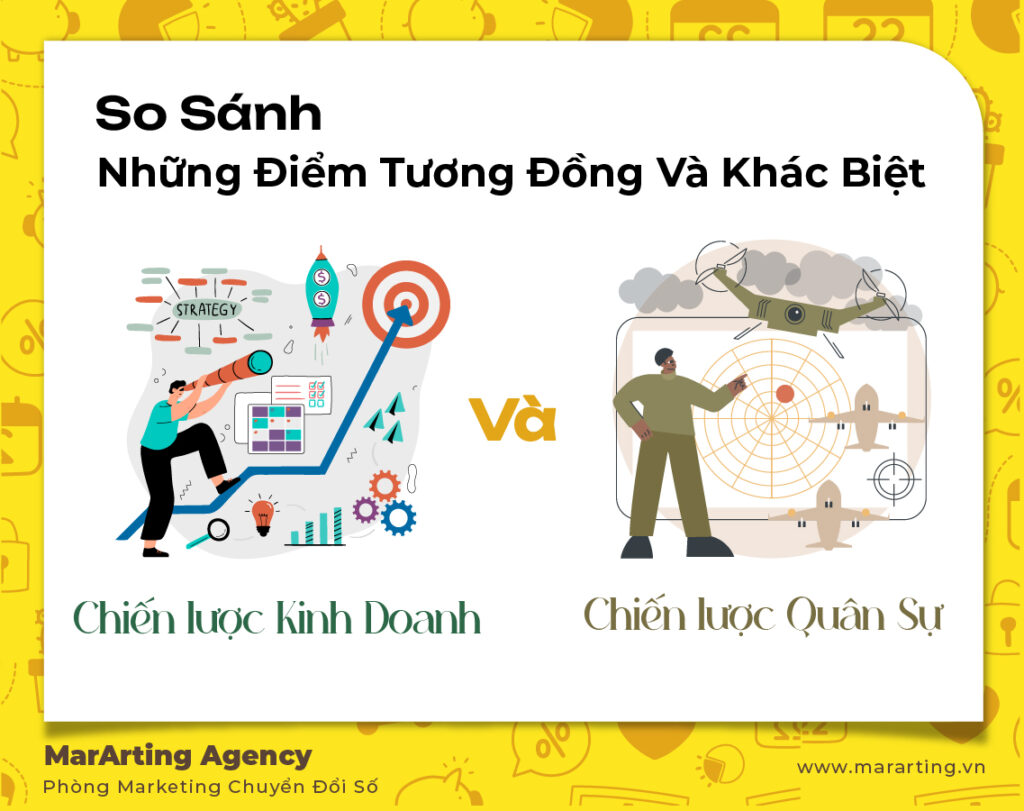
Strategy is an unfamiliar concept in both the business and military realms. Despite their different goals and contexts, business strategy and military strategy share surprising similarities. This article will compare in detail these two types of strategies, analyze their similarities and differences, from which to draw useful lessons for both areas.
Contents
1. Similarities between Business Strategy and Military Strategy

1.1. Importance of Vision and Goals
- Business Strategy Vision and objectives are the guideline for all activities of the business. A vision helps a business determine its long - term direction, while a goal concretizes that vision into measurable results.
- Military strategy: Vision and objectives also play an important role in the direction and focus of the military's efforts. A strategic vision helps define the ultimate goal of the battle, while a tactical goal concretizes the steps to be taken to achieve that goal.
1.2. Environmental Analysis
- Business Strategy Enterprises need to analyze the business environment, including the internal environment (strengths, weaknesses) and the external environment (opportunities, challenges) to make appropriate strategic decisions. Popular analytical tools include SWOT, PESTLE, Porter's Five Forces.
- Military strategy: Similarly, the army needs to thoroughly analyze the battlefield, including terrain, weather, enemy forces, and our own. This information helps commanders make accurate and effective tactical decisions.
1.3. Select and Execute Strategy
- Business Strategy Businesses need to choose a strategy that fits their resources and goals. After selecting, enterprises need to formulate a detailed action plan and implement it.
- Military strategy: Military commanders also need to choose tactics that are appropriate for the situation on the battlefield and the objectives of the battle. They will then deploy tactics by mobilizing troops, using weapons and equipment.
1.4. Evaluation and Adjustment
- Business Strategy Enterprises need to regularly assess the effectiveness of the strategy and adjust as needed to adapt to the changes of the business environment.
- Military strategy: Similarly, military commanders need to evaluate the outcome of each battle and adjust tactics if necessary.
2. Differences between Business Strategy and Military Strategy

2.1. Purposes
- Business Strategy The primary purpose is to maximize profitability and achieve a sustainable competitive advantage.
- Military strategy: The primary purpose is to win the war, defend the nation, or complete the assigned task.
2.2. Rivals
- Business Strategy Competitors are other businesses in the same industry or market.
- Military strategy: The opponent is the army of the country or other force.
2.3. Means
- Business Strategy Use tools such as marketing, products, prices, distribution, technology, ...
- Military strategy: Using weapons, military equipment, tactics, logistics, ...
2.4. Environment
- Business Strategy Competitive environments are often less fierce and have more rules.
- Military strategy: The environment of war is harsh, dangerous, and often without many rules.
2.5. Properties of Impulse
- Business Strategy Conflicts are often healthy, mutually beneficial competition.
- Military strategy: Conflict is usually direct, one - on - one combat.
3. Lesson From Military Strategy For Managing Business Strategy

Despite these differences, business strategy managers can learn a lot from military strategy, especially from Sun Tzu's ideas in the book “Tsun Tzu' s Know-How”:
- Know thyself and know thyself. The importance of understanding your own and your opponent's strengths and weaknesses.
- The despot is transformed, and the regime wins. Flexibility and adaptability to change are key to winning.
- The warrior naturally became: Find a way to win without having to fight in person.
- Righteousness, of course. Use your force in a focused way to create superior strength.
Conclusion
Business strategy and military strategy have many similarities in principles and processes, but differ in purpose, audience, means, and environment. However, both fields can learn from each other to improve efficiency. Businesses can apply lessons from military strategy to build and implement business strategies more effectively.
Translated from the Vietnamese original using VinAI Translate.
Chiến lược kinh doanh · Chiến lược quân sự · mô hình 5 lực lượng của Porter · Phân tích PESTEL · Phân tích SWOT · quản trị chiến lược · so sánh chiến lược · Sun Tzu · The Art of War